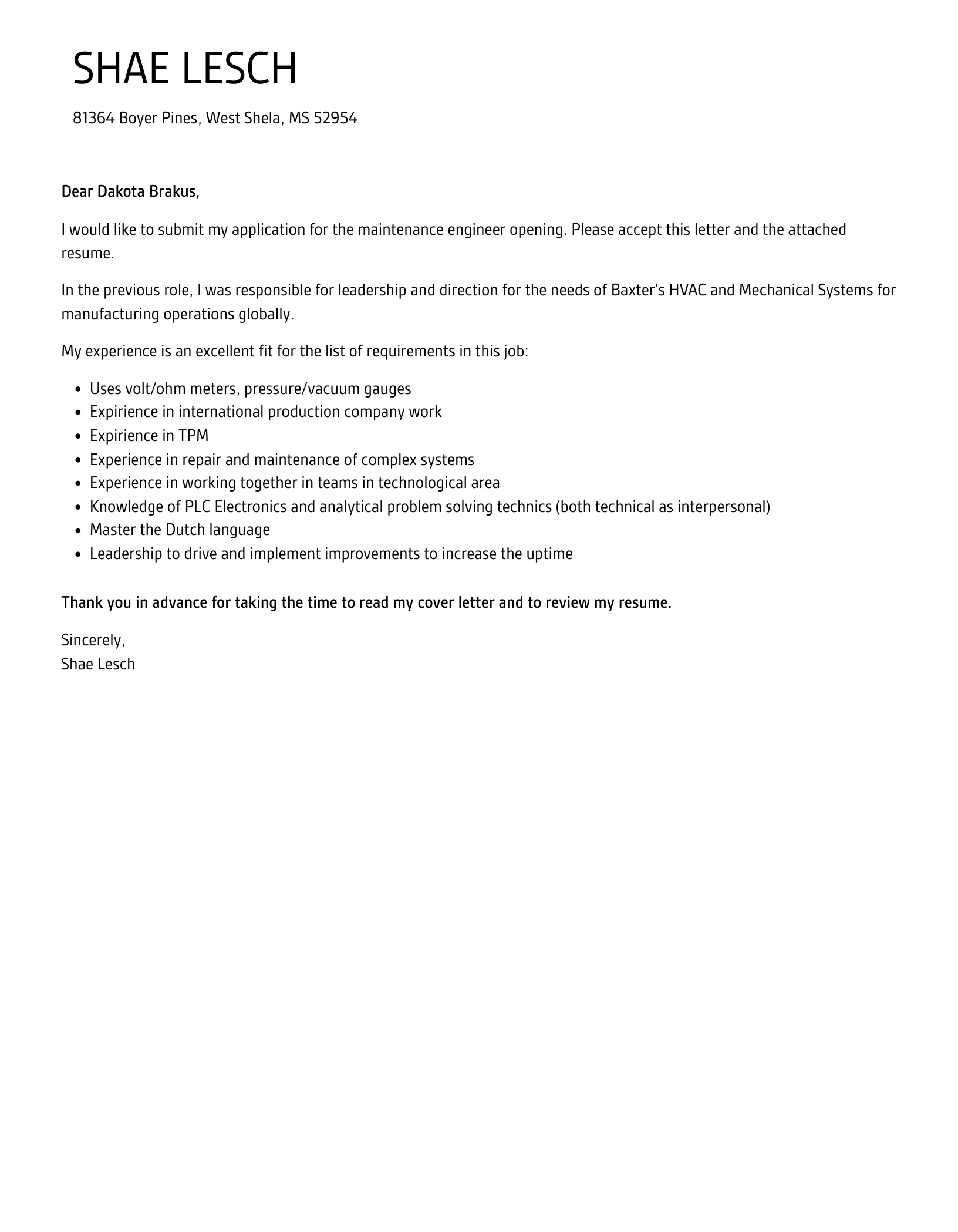
Why You Need a Stellar Maintenance Cover Letter
In the competitive job market, a well-crafted maintenance cover letter is your first impression. It serves as a crucial introduction, showcasing your skills, experience, and enthusiasm to potential employers. Unlike a resume, which provides a factual overview, a cover letter offers the opportunity to tell your story, explain your motivations, and demonstrate how your qualifications align with the specific requirements of the role. A strong cover letter can significantly increase your chances of securing an interview, setting you apart from other applicants and highlighting your suitability for the position. This document isn’t just a formality; it’s a strategic tool for career advancement in the maintenance field, demonstrating your professionalism and attention to detail.
Key Components of a Maintenance Cover Letter
A comprehensive maintenance cover letter includes several key components designed to capture the employer’s attention and highlight your qualifications. These elements work together to create a compelling narrative that effectively communicates your value. Starting with your contact information and the date ensures the letter is properly addressed. Next, providing the employer’s information indicates that you are serious about this application. A compelling salutation is essential for setting a positive tone. The body of the letter should then focus on highlighting your maintenance skills, quantifying your achievements, and showcasing relevant certifications. Finally, a strong closing that expresses enthusiasm, availability, and gratitude is important to leave a positive impression.
Your Contact Information and the Date

Begin your cover letter by providing your full name, address, phone number, and email address. This information should be placed at the top of the document, usually on the left-hand side. Directly below your contact information, include the current date. This ensures the employer can easily reach you and indicates when the letter was written. Presenting this information clearly and accurately is the first step in demonstrating professionalism and attention to detail, setting the tone for the rest of your application. Ensure the information is up-to-date and easily accessible, making it simple for the hiring manager to contact you regarding the position. Always double-check for any typos or errors.
The Employer’s Information
Following your contact details and the date, include the employer’s information. This typically includes the name of the hiring manager (if known), their title, the company name, and the company’s address. Address the letter to a specific person whenever possible; this demonstrates that you’ve done your research and are genuinely interested in the position. If the hiring manager’s name isn’t available, use a generic salutation such as ‘Dear Hiring Manager.’ This step adds a personal touch and indicates that you’ve taken the time to understand the company’s structure. Always double-check the company’s address to ensure accuracy. Using this shows that you are committed to professional application.
A Compelling Salutation
The salutation sets the tone for your cover letter, making it crucial to start strong. If you know the hiring manager’s name, use ‘Dear Mr./Ms./Mx. [Last Name].’ This personal touch shows that you’ve done your research and care about the role. If the name is unavailable, ‘Dear Hiring Manager’ or ‘Dear [Department Name] Team’ are acceptable alternatives. Avoid overly casual greetings. Ensure the salutation is formal and professional. The goal is to capture the reader’s attention from the start and set a positive, respectful tone. Your salutation is the first real interaction, so a well-chosen one can create a favorable impression.
Highlighting Your Maintenance Skills

The core of your cover letter lies in showcasing your maintenance skills. Identify the key requirements listed in the job description, then explain how your experience aligns with those needs. Provide specific examples of your accomplishments and quantify your achievements whenever possible. For instance, ‘Successfully reduced equipment downtime by 15% through preventative maintenance programs.’ Tailor your skills to the specific role; if the job requires electrical troubleshooting, highlight your expertise in that area. Use action verbs to describe your responsibilities and accomplishments. Be clear, concise, and demonstrate your value to the potential employer. Show that you can handle tasks effectively.
Technical Skills for Maintenance Positions
Technical skills are the backbone of any successful maintenance professional. Focus on abilities such as electrical and mechanical troubleshooting, plumbing, carpentry, and HVAC system repair. Include experience with specific tools and equipment, like multimeters, power tools, and diagnostic software. Mention your proficiency in reading blueprints, schematics, and technical manuals. If the job involves specialized equipment, emphasize your experience with that machinery. Highlight any certifications or training in areas like welding, refrigeration, or building automation. This demonstrates your capability to handle a wide range of maintenance tasks effectively. Displaying your technical prowess is a strong way to show your value.
Soft Skills for Maintenance Success
While technical skills are essential, soft skills play a crucial role in maintenance. Emphasize your communication, problem-solving, and time management abilities. Highlight your teamwork skills, ability to work independently, and adaptability. Mention your attention to detail, organizational skills, and ability to follow safety protocols. These soft skills demonstrate that you can work well with others, handle complex tasks efficiently, and ensure a safe work environment. Mention specific instances where you used these skills to solve problems, collaborate with a team, or improve efficiency. Focusing on soft skills is very useful.
Quantifying Your Achievements

Quantifying your achievements makes your cover letter more impactful and demonstrates your value. Instead of saying you ‘improved efficiency,’ state you ‘increased efficiency by 20% by implementing a new maintenance schedule.’ Provide specific metrics and data whenever possible. If you reduced downtime, mention the percentage or the number of hours saved. If you completed projects on time and within budget, provide those details. Quantifiable achievements show the employer the tangible results you’ve delivered in previous roles. Using numbers provides concrete evidence of your skills and contributions, distinguishing your application from others. This concrete data will make you seem like a very suitable candidate.
Showcasing Your Certifications and Training
Certifications and training are essential for maintenance positions and should be prominently displayed in your cover letter. List all relevant certifications, such as those from the Building Owners and Managers Association (BOMA), the Association for Facilities Engineering (AFE), or specific trade certifications (e.g., HVAC, electrical). Mention any specialized training, such as safety courses, equipment-specific training, or courses in project management. Include the issuing organization and the dates of completion. This shows that you have the necessary knowledge, skills, and commitment to professional development. This evidence of commitment to your profession is a great asset.
Tailoring Your Cover Letter to the Job
One of the most critical aspects of a successful cover letter is tailoring it to each job you apply for. Avoid using a generic cover letter; customize it to align with the specific requirements outlined in the job description. Carefully review the job posting, identify the key skills and qualifications the employer is seeking, and highlight how your experience matches those needs. Use keywords from the job description throughout your letter. Show that you understand the company and the role and that you’ve taken the time to create an application specifically for them. This demonstrates your genuine interest and attention to detail, making a strong impression.
Researching the Company and the Role

Before you start writing, research the company and the specific role. Visit the company’s website to understand their mission, values, and recent projects. Learn about their industry, their culture, and any recent news or achievements. This knowledge will help you tailor your cover letter to showcase your understanding of their needs and how you can contribute. Understand the role’s responsibilities and the skills required. Use this information to demonstrate how your experience aligns with the company’s goals and the specific requirements of the position. This is a good way to appear like a top candidate.
Matching Skills and Experience to Requirements
Once you understand the company and the role, match your skills and experience to the job’s requirements. Identify the key skills and qualifications listed in the job description and provide specific examples of how you’ve demonstrated those skills in previous roles. Use the same keywords and phrases from the job posting. Clearly articulate how your experience aligns with their needs and how you can add value to their team. Quantify your accomplishments whenever possible and highlight any relevant certifications or training. By directly addressing the requirements, you demonstrate that you are a suitable candidate for the position and are truly interested in the job at hand.
Proofreading and Editing Your Cover Letter
Proofreading and editing are crucial steps in creating a professional cover letter. Errors in grammar, spelling, and punctuation can undermine your credibility and make a negative impression. Review your letter multiple times, checking for any typos, grammatical errors, or inconsistencies. Consider asking a friend, family member, or career counselor to review your letter as well. Ensure that your formatting is consistent, the language is clear and concise, and the tone is professional. A well-proofread and edited cover letter shows that you are detail-oriented and committed to producing high-quality work, reflecting well on your abilities.
The Importance of a Strong Closing

The closing paragraph provides the opportunity to leave a lasting positive impression. Reiterate your interest in the position and thank the hiring manager for their time and consideration. State your enthusiasm for the opportunity and your confidence in your ability to contribute to the company’s success. Express your availability for an interview and indicate how you can be contacted. Your closing should be professional, enthusiastic, and leave the hiring manager with a clear understanding of your value. A strong closing ensures that the employer remembers you and encourages them to take the next step in the hiring process. This part can be a great tool for getting hired.
Expressing Enthusiasm and Availability
In your closing, express your enthusiasm for the position and the company. Reiterate your interest in the role and your eagerness to contribute to the team. Make it clear that you are excited about the opportunity and believe you possess the skills and experience necessary to succeed. Additionally, indicate your availability for an interview. State that you are readily available to discuss your qualifications in further detail and can be reached at your provided contact information. Expressing enthusiasm and availability leaves a positive impression, making the hiring manager more likely to consider your application favorably. This is one of the best ways to get yourself noticed.
Thanking the Hiring Manager
Always thank the hiring manager for their time and consideration. Express your appreciation for the opportunity to apply for the position and for the time they’ve spent reviewing your application. A simple ‘Thank you for your time and consideration’ is appropriate. This gesture is courteous and shows respect for the hiring process. Ending your cover letter with gratitude leaves a positive impression, signaling that you value the opportunity and are appreciative of their efforts. Thanking the hiring manager is a sign of professionalism, showing your gratitude.
Formatting and Presentation Tips

Formatting and presentation significantly impact the readability and professionalism of your cover letter. Use a clean, easy-to-read font such as Times New Roman, Arial, or Calibri, with a font size of 11 or 12 points. Ensure your letter has consistent spacing and alignment. Use a standard business letter format, including clear margins and spacing between paragraphs. Avoid excessive use of bolding, italics, or underlining. Keep your letter concise, ideally within one page. Proofread the entire document carefully to avoid any formatting errors. A well-formatted cover letter demonstrates professionalism and attention to detail, making it easier for the hiring manager to read and understand your qualifications. This is the best way to be a standout candidate.
Common Mistakes to Avoid
Certain mistakes can significantly reduce the effectiveness of your cover letter. Avoiding these common errors can dramatically improve your chances of getting hired. Using generic language, neglecting to proofread, and failing to tailor your letter are the most frequent pitfalls. By being mindful of these common errors, you can significantly enhance the impact of your cover letter and increase your chances of making a strong impression on potential employers. This helps you create a well-structured cover letter.
Using Generic Language
Avoid using generic language that could apply to any job. Instead of saying you’re ‘a team player,’ provide specific examples of how you’ve collaborated with others. Instead of claiming you ‘have strong communication skills,’ describe how you effectively communicated in previous roles. Avoid clichés and overused phrases. Tailor your language to the specific requirements of the job and highlight your unique skills and experiences. Generic language makes your cover letter seem impersonal and fails to showcase what sets you apart from other applicants. By using specific examples and tailored language, you make it easier for the employer to see why you’re the best person for the job.
Neglecting to Proofread
Neglecting to proofread is a major mistake that can damage your credibility. Errors in grammar, spelling, and punctuation make a negative impression and suggest a lack of attention to detail. Always proofread your cover letter multiple times, carefully checking for any mistakes. Consider asking a friend or family member to proofread your letter as well. Read your letter aloud, as this can help you catch errors you might miss when reading silently. A well-proofread cover letter demonstrates professionalism and attention to detail, reinforcing your qualifications.
Failing to Tailor Your Letter
Sending a generic cover letter to multiple employers is a common error that can significantly reduce your chances of getting hired. Tailoring your cover letter to each job is crucial. Customize your letter to match the specific requirements and keywords in the job description. Research the company and the role, and demonstrate how your skills and experience align with their needs. Show that you understand the company’s mission, values, and culture. A tailored cover letter demonstrates your genuine interest in the position and your commitment to making a strong impression on the hiring manager. This is the most effective way to create a good cover letter.
Cover Letter Examples for Different Maintenance Roles
Different maintenance roles require different skills and experiences, and your cover letter should reflect this. Tailor your cover letter to the specific job you’re applying for, highlighting the skills and experiences most relevant to that role. Always review the job description to identify the key requirements and tailor your cover letter accordingly. Here are examples of cover letters for Maintenance Technician, Maintenance Manager, and Building Maintenance Worker.
Maintenance Technician Cover Letter
A maintenance technician cover letter should highlight your technical skills and hands-on experience. Emphasize your expertise in troubleshooting, repairs, and preventative maintenance. Highlight your ability to work with different equipment, such as electrical systems, plumbing, and HVAC systems. Include any certifications and training related to these areas. Quantify your achievements, such as reducing downtime or improving efficiency. Tailor your letter to the specific requirements of the job, such as experience with particular equipment or systems. This will show you are truly suited to the job.
Maintenance Manager Cover Letter
A maintenance manager cover letter should focus on leadership, management, and strategic planning skills. Emphasize your experience in managing teams, developing maintenance schedules, and overseeing budgets. Highlight your ability to implement preventative maintenance programs and improve efficiency. Include any experience with regulatory compliance and safety protocols. Quantify your achievements, such as reducing costs or improving equipment performance. Tailor your letter to the specific requirements of the job, such as experience with specific industries or management styles. Leadership skills are key in a maintenance manager role, so emphasize your management and leadership skills.
Building Maintenance Worker Cover Letter
A building maintenance worker cover letter should focus on your general maintenance skills and experience in building upkeep. Highlight your skills in various areas, such as plumbing, electrical work, carpentry, and painting. Include any experience with groundskeeping or landscaping. Emphasize your ability to perform routine maintenance tasks and respond to emergency repairs. Mention your ability to follow safety protocols and maintain a clean and organized work environment. Tailor your letter to the specific requirements of the job, such as experience with certain tools or systems. Having the right skills is a great way to show you’re suited to the role.
Final Thoughts on Maintenance Cover Letters
A well-crafted maintenance cover letter is a powerful tool that can significantly improve your chances of landing your dream job. By following these guidelines, tailoring your letter to each job, and showcasing your skills and experience effectively, you can make a strong impression on potential employers. Remember to proofread and edit your letter carefully, and always express your enthusiasm for the opportunity. Your cover letter is your chance to present yourself as the ideal candidate, so take the time to craft a compelling and professional document. Make a great first impression to increase your chances of getting hired.