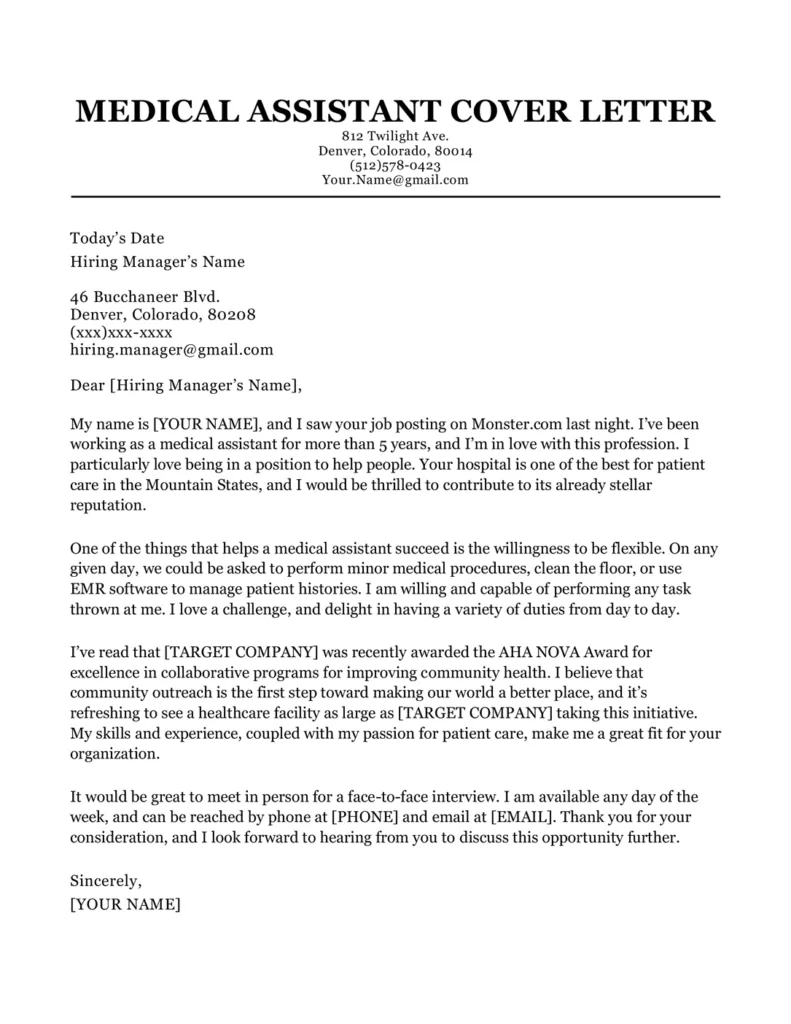
Medical Assistant Cover Letter Secrets
Landing your dream job as a Medical Assistant requires more than just a stellar resume; it demands a compelling cover letter. This crucial document is your opportunity to showcase your personality, highlight your skills, and demonstrate your genuine interest in the position. Many job seekers overlook the power of a well-crafted cover letter, missing out on opportunities to make a lasting impression. This guide unveils the secrets to writing a medical assistant cover letter that captivates employers and sets you apart from the competition. Discover how to tailor your letter to each specific job, emphasize your most relevant skills, and ultimately secure that all-important interview.
Understanding the Purpose of a Cover Letter
A cover letter serves as your personal introduction to a potential employer. Unlike your resume, which provides a factual overview of your experience and qualifications, your cover letter gives you a platform to communicate your personality, enthusiasm, and specific reasons for applying. It allows you to explain how your skills align with the job requirements and why you are the perfect fit for the role and the organization. The best medical assistant cover letters go beyond simply repeating information from the resume; they tell a story, highlighting your passion for healthcare and your commitment to patient care. It’s a chance to make a human connection before the interview.
Why a Cover Letter is Crucial for Medical Assistants

In the competitive field of healthcare, a cover letter can be the deciding factor in securing an interview. For medical assistants, it’s particularly important because it allows you to showcase your patient-care approach, your understanding of medical terminology, and your ability to work as part of a team. A well-written cover letter demonstrates your communication skills, which are vital for interacting with patients and other healthcare professionals. Furthermore, it provides an opportunity to address any gaps in your resume, such as a career change or a period of unemployment, providing context and reassuring the hiring manager. It shows you’ve taken the time to personalize your application.
Key Components of a Medical Assistant Cover Letter
Header and Contact Information
Begin your cover letter with a professional header that includes your full name, address, phone number, and email address. This information should be clearly displayed at the top of the document, matching the information on your resume. Also, include the date and the employer’s contact information, including the hiring manager’s name and title if available. If you are unsure of the hiring manager’s name, research the clinic’s or practice’s website or LinkedIn to find it. Proper formatting is essential; ensure your contact details are accurate and easy to read. This section immediately provides the information necessary to contact you.
Personalized Salutation

Address your cover letter to a specific person whenever possible. ‘Dear Mr./Ms. [Last Name]’ is much more effective than a generic greeting like ‘To Whom It May Concern’ or ‘Dear Hiring Manager.’ Researching the hiring manager’s name shows that you have taken the time to personalize your application and demonstrates a genuine interest in the position. If you are unable to find the hiring manager’s name, you can use a more general, but still professional, greeting such as ‘Dear Hiring Committee’ or ‘Dear [Clinic Name] Team.’ This personalization helps to establish a connection from the start.
Opening Paragraph Grab Attention
The opening paragraph is your first chance to capture the reader’s attention. It should immediately state the position you are applying for and how you learned about the opportunity. Then, state your most impressive qualification or a key skill that makes you stand out. Briefly express your enthusiasm for the role and the organization. Consider mentioning something specific that drew you to this particular opportunity, demonstrating that you have done your research. Avoid generic phrases; instead, aim for a concise and engaging opening that piques the reader’s interest and encourages them to continue reading the rest of your letter.
Highlighting Relevant Skills and Experience
Showcasing Clinical Skills

Medical assistants possess a diverse skillset, and your cover letter should highlight the clinical skills most relevant to the job. Mention your proficiency in taking patient histories, measuring vital signs, assisting with examinations and procedures, and administering medications. If you have experience with specific medical equipment or software, be sure to include that information. Quantify your skills whenever possible; for example, ‘Administered injections to an average of 20 patients per day’ or ‘Assisted with over 50 minor surgical procedures.’ Clearly demonstrate that you are capable of performing the essential duties required by the role.
Emphasizing Soft Skills
While clinical skills are essential, soft skills are equally important. Highlight your communication, empathy, and teamwork abilities. Mention your ability to explain medical information clearly to patients, your experience in handling difficult situations, and your commitment to patient confidentiality. Provide specific examples that demonstrate your soft skills in action. For example, ‘Successfully resolved patient concerns by actively listening and providing clear, concise explanations.’ or ‘Collaborated effectively with a team of nurses and physicians to ensure efficient patient care.’ Employers value medical assistants who are not only technically proficient but also possess excellent interpersonal skills.
Quantifying Achievements
Instead of simply listing your responsibilities, use your cover letter to quantify your achievements. Provide specific examples of how you have positively impacted previous employers. Did you improve patient satisfaction scores? Did you streamline a process that saved time or resources? Did you contribute to a team that received an award? Use numbers and data to illustrate your accomplishments, making your contributions more tangible and memorable. For example, ‘Reduced patient wait times by 15% by implementing a new check-in system’ or ‘Increased patient compliance by 10% through improved patient education.’ This data provides tangible proof of your capabilities.
Addressing the Employer’s Needs

Researching the Clinic or Practice
Before writing your cover letter, thoroughly research the clinic or practice to which you are applying. Visit their website, read patient reviews, and browse their social media pages. Identify their values, mission, and the services they provide. Tailor your cover letter to reflect your understanding of their needs and demonstrate how your skills and experience align with their specific requirements. Mentioning something specific about the clinic, like their focus on a particular specialty or their commitment to patient-centered care, shows that you’ve done your homework and are genuinely interested in joining their team.
Tailoring the Letter to the Job Description
Carefully review the job description and identify the key skills and qualifications the employer is seeking. Use these keywords and phrases in your cover letter, but avoid simply restating the job description. Instead, provide specific examples of how you have demonstrated these skills in your previous roles. Highlight your relevant experience and achievements, and explain how you can contribute to the clinic or practice’s success. Customize your cover letter for each job application to demonstrate your commitment and your ability to meet the employer’s needs.
Closing the Cover Letter Call to Action

Expressing Enthusiasm and Gratitude
In your closing paragraph, reiterate your enthusiasm for the position and the organization. Express your gratitude for the reader’s time and consideration. Restate your interest in an interview and make it easy for them to contact you. Keep the tone positive and professional, and avoid any overly casual language. A strong closing leaves a lasting positive impression, encouraging the reader to take the next step and contact you about the opportunity.
Professional Closing and Signature
Conclude your cover letter with a professional closing, such as ‘Sincerely,’ ‘Respectfully,’ or ‘Thank you.’ Leave space for your signature if you are submitting a hard copy, or type your full name if you are submitting it electronically. Ensure your contact information is clearly visible at the top of your letter, making it easy for the employer to reach you. Proofread your entire cover letter carefully before submitting it to ensure there are no errors in grammar, spelling, or punctuation. A well-written and error-free cover letter demonstrates professionalism and attention to detail, qualities highly valued in the healthcare industry.