Understanding the Importance of a Strong Cover Letter for Nursing Graduates
As a nursing graduate, your cover letter is your first introduction to potential employers. It’s more than just a formality; it’s your opportunity to showcase your personality, skills, and passion for nursing. A well-crafted cover letter can significantly increase your chances of landing an interview and ultimately, your dream job. This document allows you to expand on your resume, providing context and detail that a list of qualifications cannot. It’s your chance to articulate why you’re the perfect fit for the specific role and organization. A compelling cover letter demonstrates your communication skills, attention to detail, and genuine interest in the position. Consider it your personal sales pitch, designed to persuade the hiring manager that you’re worth a closer look. Without a strong cover letter, your application may be overlooked, regardless of your qualifications.
Key Components of a Nursing Graduate Cover Letter
A successful cover letter comprises several essential elements. Firstly, you need your contact information, including your name, phone number, email, and optionally, your LinkedIn profile link. Then, include the date and the hiring manager’s name and title, if known, as a sign of your research and initiative. The body of the letter should start with a compelling opening, immediately grabbing the reader’s attention. It should then highlight your educational background, detailing your nursing degree, GPA (if impressive), and any relevant coursework. Next, elaborate on your clinical experiences, mentioning specific skills and accomplishments. Quantify your achievements whenever possible using numbers or data. Finally, your cover letter should conclude with a strong closing statement and a clear call to action, expressing your enthusiasm for the role and your availability for an interview. Careful attention to each component ensures a professional and impactful cover letter.
Your Contact Information and the Date

Begin your cover letter by providing your contact details. This should be placed at the top of the document and include your full name, address, phone number, and professional email address. Ensure your email address is appropriate and professional. Following your contact information, include the date. This is the date you are submitting your application. These details are essential for the employer to contact you easily. Accuracy and neatness are vital in this section. Consider using a clear and easy-to-read font for this information. This ensures that the hiring manager can quickly find and access your contact details if they want to reach out to you for an interview. Proper formatting here also reflects your attention to detail, a crucial quality for a nurse.
Addressing the Hiring Manager
Addressing the hiring manager by name personalizes your cover letter and shows that you’ve done your research. If you know the name of the hiring manager (e.g., Nurse Manager, Director of Nursing), use it. You can often find this information on the job posting or the organization’s website. If you’re unsure of the hiring manager’s name, you can address the letter to the “Hiring Manager” or “Recruitment Team.” Avoid generic greetings like “To Whom It May Concern,” as they come across as impersonal. When addressing the hiring manager, use their correct title and be formal and respectful. This simple step can make a significant impact and show you are attentive to detail. It demonstrates your commitment and initiative and sets a positive tone for the rest of your cover letter. The right salutation can help your application stand out.
Highlighting Your Nursing Education and Credentials
In the body of your cover letter, prominently showcase your nursing education and credentials. Clearly state your degree (e.g., Bachelor of Science in Nursing, Associate Degree in Nursing) and the name of the institution from which you graduated. If you have a strong GPA, consider including it, especially if it’s above average. Mention any academic honors or scholarships you received. Also, include your licensure information, such as your Registered Nurse (RN) license number and the state in which you are licensed. If you have any certifications, such as BLS, ACLS, or others relevant to the position, make sure to include them as well. Highlighting your education and credentials gives the hiring manager confidence in your qualifications and expertise. Ensure this section is accurate and easy to read.
Showcasing Relevant Clinical Experience and Skills

One of the most critical sections in your cover letter is showcasing your clinical experience and relevant skills. Describe your clinical rotations and the specific areas you’ve worked in, such as medical-surgical, ICU, pediatrics, or emergency room. Provide details about your responsibilities and the types of patients you cared for. Emphasize the skills you acquired and utilized, such as medication administration, wound care, patient assessment, and electronic health record documentation. Tailor your skills to match the requirements mentioned in the job description. For example, if the job description emphasizes teamwork, provide examples of how you’ve collaborated with other healthcare professionals. Demonstrate your ability to think critically, solve problems, and provide compassionate care. This section is where you bring your resume to life.
Quantifying Achievements and Using Action Verbs
To make your cover letter more compelling, quantify your achievements whenever possible. Instead of saying “Provided excellent patient care,” try “Administered medications to over 50 patients daily, consistently achieving positive patient outcomes.” Use action verbs to start your sentences, as this conveys your skills and experiences actively. Examples include “Assessed,” “Administered,” “Collaborated,” “Educated,” “Managed,” “Trained,” and “Developed.” When describing your accomplishments, use the STAR method (Situation, Task, Action, Result) to provide context and demonstrate your impact. For instance, describe the situation, the task you were assigned, the actions you took, and the resulting outcome. This method helps create a clear and concise narrative that showcases your skills and contributions effectively. Use these strategies to make your letter stand out.
Demonstrating Your Passion for Nursing
Demonstrating your passion for nursing is essential in your cover letter. Express your genuine enthusiasm for the profession and your commitment to providing excellent patient care. Describe what motivates you to be a nurse, what aspects of nursing you find most rewarding, and why you chose this career path. Show how your values align with the mission and values of the healthcare organization you are applying to. Mentioning specific experiences or moments that ignited your passion can be impactful. For example, you could share an experience where you made a positive impact on a patient’s life. Be authentic and heartfelt in your expression of your love for nursing. This genuine passion will make you more memorable to the hiring manager and reflect your dedication to the role.
Tailoring Your Cover Letter to Each Application

Avoid using a generic cover letter for all your applications. Customize each cover letter to match the specific job requirements and the healthcare organization you are applying to. Review the job description carefully and identify the key skills and experiences the employer is seeking. Highlight your relevant qualifications and skills that align with their needs. Research the organization’s mission, values, and culture, and explain why you are a good fit. Tailoring your cover letter demonstrates your interest and attention to detail. It shows the hiring manager you’ve put in the effort to understand the specific requirements of the position and the organization. Customization significantly increases your chances of getting noticed and securing an interview.
Using Keywords to Optimize Your Cover Letter
To optimize your cover letter, incorporate keywords from the job description throughout your text. Recruiters often use Applicant Tracking Systems (ATS) to scan applications, and keywords help your application get past these systems. Identify the most important skills, qualifications, and experience mentioned in the job description. Weave these keywords naturally into your cover letter. However, don’t overdo it; your cover letter should still be readable and engaging. Focus on using relevant keywords within the context of your experiences and accomplishments. This helps your application stand out and shows that you possess the skills and qualifications the employer is seeking. Remember to maintain a balance between keyword optimization and a natural, well-written narrative.
Formatting and Proofreading Your Cover Letter
Formatting and proofreading your cover letter are crucial steps in ensuring a professional and polished document. Use a clear and easy-to-read font, such as Arial or Times New Roman, with a font size between 11 and 12 points. Maintain consistent formatting throughout your cover letter, including margins, spacing, and paragraph alignment. Proofread your cover letter carefully for any grammatical errors, spelling mistakes, and typos. Read it aloud to catch any awkward phrasing or unclear sentences. Consider having a friend or mentor review your cover letter for feedback. A well-formatted and error-free cover letter demonstrates your attention to detail and professionalism, which are essential qualities for a nurse. Ensure your cover letter is easy to read and visually appealing.
Common Mistakes to Avoid in Your Nursing Cover Letter

Several common mistakes can hurt your chances of success. Avoid using a generic cover letter that’s not tailored to the specific job. Don’t simply restate your resume; use your cover letter to elaborate on your experiences and accomplishments. Ensure you avoid grammatical errors, spelling mistakes, and typos. Don’t make the letter too long; aim for one page. Avoid negative language or complaining about previous employers. Do not include salary expectations unless specifically requested. Always proofread your cover letter multiple times before submitting it. By avoiding these common errors, you can ensure your cover letter presents you as a highly qualified and professional candidate.
The Power of a Strong Closing Statement
Your closing statement should leave a lasting positive impression. Reiterate your interest in the position and express your enthusiasm for the opportunity. Briefly summarize why you are a good fit for the role, highlighting your key skills and experiences. Clearly state your availability for an interview. Thank the hiring manager for their time and consideration. Using a confident and professional tone shows you are eager and prepared. This helps the hiring manager to remember you and consider you as a strong contender. A well-written closing statement helps you to stand out.
Expressing Gratitude and Following Up
After submitting your cover letter and resume, express gratitude to the hiring manager for considering your application. Then, follow up appropriately. Send a thank-you email within a week of your interview to reiterate your interest and thank the interviewer for their time. If you haven’t heard back within the timeframe specified in the job posting (or within two to three weeks), consider sending a polite follow-up email to inquire about the status of your application. Expressing gratitude and following up shows your professionalism and enthusiasm for the position. It also reminds the hiring manager of your interest and commitment. These steps can give you an edge over other candidates.
Example Cover Letter Templates for Nursing Graduates

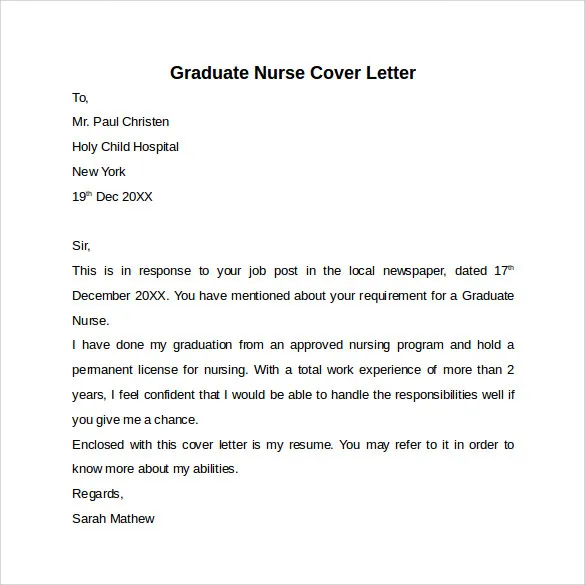
Consider using cover letter templates as a starting point. Numerous online resources offer cover letter templates tailored for nursing graduates. These templates provide a framework for organizing your information and can help you ensure you include all the necessary components. However, it’s crucial to personalize the template to reflect your experiences, skills, and the specific job you are applying for. Adapt the template to match the organization’s culture and the job requirements. This ensures your cover letter stands out and highlights your qualifications effectively. A well-personalized template can save you time and help you create a professional and compelling cover letter. Customize the template to your specific needs.