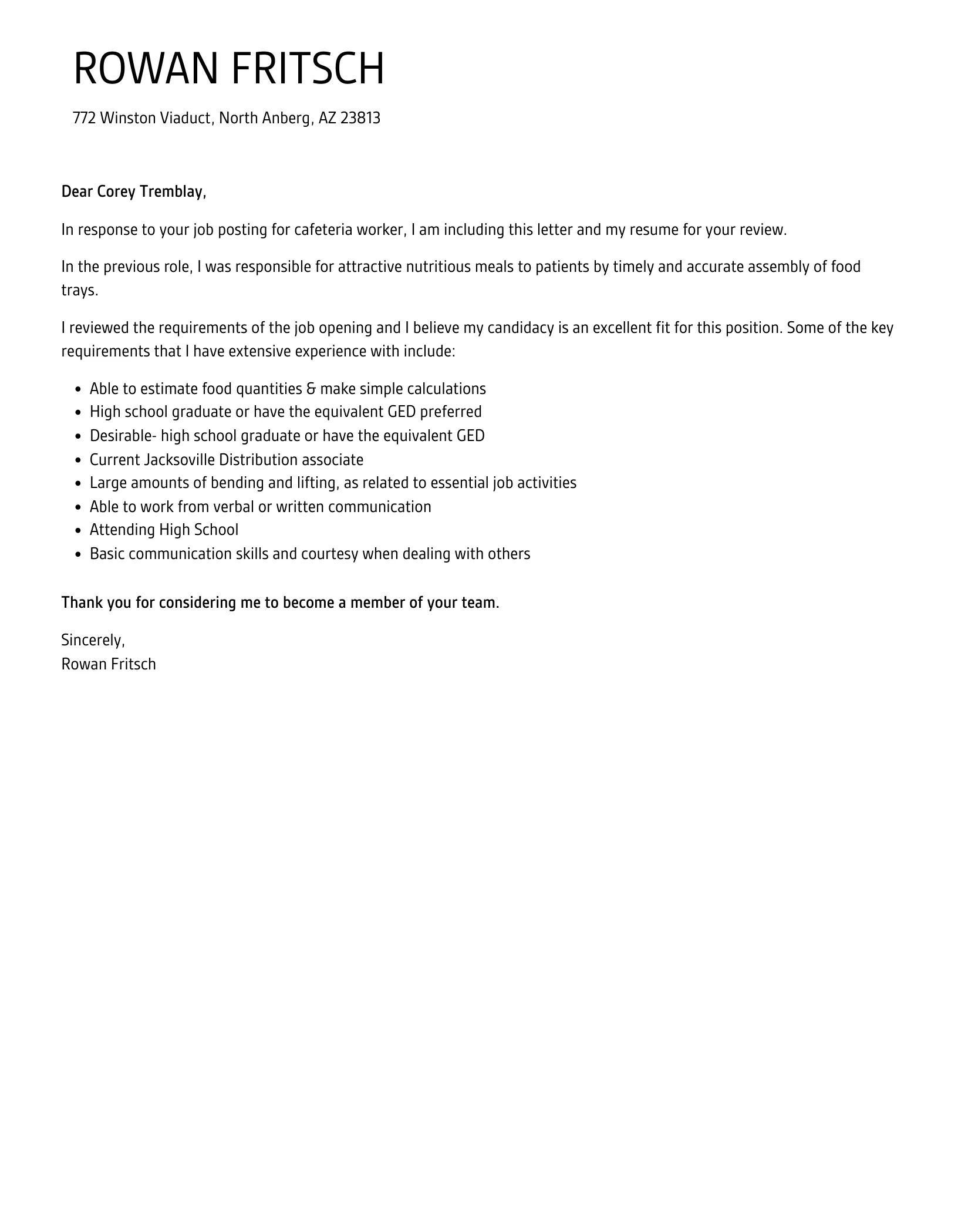
Why a Strong School Cafeteria Worker Cover Letter Matters
In the competitive landscape of job applications, your cover letter is your first impression. A well-crafted school cafeteria worker cover letter can significantly increase your chances of landing an interview and ultimately securing the position. It’s not just a formality; it’s a crucial tool to showcase your skills, experience, and enthusiasm for the role. A strong cover letter provides an opportunity to highlight what makes you the ideal candidate and demonstrate your understanding of the job requirements and school environment. This document serves as your advocate, allowing you to present yourself effectively and make a compelling case for why you deserve to be hired. By clearly articulating your qualifications and passion, you can make a positive impression and set yourself apart from other applicants. It’s a chance to show you’re not just qualified, but also a great fit for the school community.
Highlighting Your Skills and Experience
Your cover letter should effectively highlight the skills and experience most relevant to the school cafeteria worker role. This involves clearly stating your past experiences, such as any prior food service positions you’ve held, and quantifying your achievements whenever possible. Did you manage inventory? Mention the number of items you tracked or the value you oversaw. Did you improve customer satisfaction? Detail the methods you employed and the positive outcomes achieved. This approach allows the hiring manager to quickly grasp the value you bring to the table. Use action verbs to describe your responsibilities, such as ‘prepared,’ ‘served,’ ‘managed,’ and ‘maintained.’ Providing concrete examples of your skills in action will make your claims more credible and memorable. The goal is to create a narrative that positions you as a problem-solver and an asset to the school’s food service team.
Relevant Skills for a School Cafeteria Worker

A school cafeteria worker requires a diverse set of skills. First, consider your proficiency in food preparation. Can you follow recipes, handle food safely, and ensure meals meet nutritional guidelines? Secondly, efficient serving skills are key. Speed and accuracy in serving students are essential to minimize wait times and manage lunch periods smoothly. Additionally, you’ll need strong organizational abilities. Managing inventory, handling cash, and maintaining a clean workspace are all crucial. Furthermore, the role demands the ability to work both independently and as part of a team, assisting other staff members and collaborating effectively. The ideal candidate also demonstrates adaptability, as school cafeteria environments can be fast-paced and constantly changing. Finally, familiarity with food safety protocols and health regulations is essential to ensure compliance and the well-being of students.
Experience in Food Service
Detailing your food service experience is critical to showcasing your readiness for the role. Focus on relevant past experiences, such as working in restaurants, cafeterias, or catering services. Describe the tasks you performed, emphasizing any responsibilities that align with the job description. Did you handle food preparation, operate kitchen equipment, or manage inventory? Quantify your achievements whenever possible. For example, if you were responsible for managing food orders, mention the number of orders you processed daily or the value of food you handled. Highlighting your familiarity with food safety practices, such as handling and storing food according to health regulations, is also important. Finally, always frame your experience in a way that demonstrates your ability to adapt to a school environment, specifically your understanding of serving children.
Customer Service Abilities
Customer service is an integral part of a school cafeteria worker’s responsibilities. You will be interacting with students, faculty, and occasionally parents. Highlight your ability to provide friendly, efficient, and courteous service. Explain how you handle customer inquiries, resolve issues, and maintain a positive attitude. Did you receive any customer service awards or recognition? Mention them. Demonstrate your patience, understanding, and ability to handle different personalities. Additionally, showcasing your communication skills is vital. Can you clearly explain menu items, handle special dietary requests, and interact with students of various ages? Emphasize your ability to create a welcoming and positive environment where students feel comfortable and respected.
Essential Qualities for Success

Beyond technical skills, certain qualities are essential for success in a school cafeteria worker role. These qualities ensure that you will fit in the team and perform your job effectively. Focus on highlighting qualities like reliability, organization, and the capacity to work under pressure. Consider highlighting your ability to work effectively in a team environment, which is crucial for smooth operations during busy lunch periods. Your ability to remain calm and collected in fast-paced settings is also a significant asset. Ultimately, the ideal candidate demonstrates a genuine commitment to providing nutritious meals and creating a positive dining experience for students.
Attention to Detail
Attention to detail is crucial in the school cafeteria environment. This includes adhering to recipes, accurately measuring ingredients, and ensuring that all food items meet safety standards. The ability to follow instructions precisely is essential for consistency and quality. Highlight your ability to maintain cleanliness and organization in the kitchen, adhering to hygiene protocols and preventing cross-contamination. Mention your experience with inventory management and how you ensure that supplies are properly stored and accounted for. Accuracy in cash handling and order processing is also essential. For instance, share an example of how you have prevented errors in the past or have identified and corrected mistakes. Demonstrating your meticulous approach to all tasks will showcase your reliability and commitment to quality.
Teamwork and Collaboration
Working effectively within a team is essential in a school cafeteria. Highlighting your collaborative skills can greatly enhance your application. Describe your experience working in a team environment, mentioning specific instances where you successfully collaborated with colleagues to achieve common goals. Share examples of how you communicated effectively, shared responsibilities, and supported your coworkers. Detail how you have resolved conflicts, contributed to a positive work atmosphere, and worked together efficiently during busy service periods. Showcasing your ability to assist others, share knowledge, and maintain a respectful and cooperative attitude will make you an attractive candidate. Remember, school cafeterias thrive on teamwork, so demonstrating your proficiency in this area is invaluable.
Crafting Your Cover Letter

Crafting a compelling cover letter involves several key elements that help make a positive impression. Your cover letter should be clear, concise, and tailored to the specific role you are applying for. It must include all the necessary information and effectively communicates your qualifications and enthusiasm for the position. Following the correct structure and writing style is essential. Furthermore, demonstrating professionalism and attention to detail will make your letter stand out. The effort you put into the crafting process will make you a strong candidate.
Header and Contact Information
Begin your cover letter with a professional header containing your contact information. Include your full name, phone number, email address, and your mailing address. Directly below this, include the date. After the date, include the hiring manager’s name (if available), title, and the school’s address. Ensure all contact details are accurate and easy to read. Using a professional format and ensuring the information is correctly presented will make a strong first impression, demonstrating your attention to detail and professionalism. Always double-check the information before submitting to avoid any errors.
Opening Paragraph that Grabs Attention
The opening paragraph is your first opportunity to capture the reader’s attention. Start with a strong statement that immediately conveys your interest in the position. Mention the specific role you are applying for and where you saw the job posting. Briefly state why you are interested in the position and the school. Tailor your opening to express your enthusiasm and what skills and experiences you have that align with the job. Keep it concise and focused, demonstrating that you understand the school’s mission and the specific requirements of the role. Making a great first impression will encourage the reader to continue reading and learn more about you.
Body Paragraphs Highlighting Qualifications

The body paragraphs should be the core of your cover letter, providing a detailed account of your qualifications. Use these paragraphs to highlight your relevant skills and experiences in food service. Detail your past accomplishments and responsibilities. Use specific examples and quantifiable results, such as the number of meals you prepared or improvements you made in inventory management. Reference the job description and tailor your responses to match the stated requirements. Emphasize any experience with customer service, food safety, or team collaboration. Structure your paragraphs logically, with each one focusing on a key skill or experience. This will help the reader understand your suitability for the role.
Closing Paragraph and Call to Action
Conclude your cover letter with a strong closing paragraph that summarizes your interest in the position and reiterates your suitability. Restate your enthusiasm for the opportunity and the school. Thank the hiring manager for their time and consideration. Include a call to action, such as expressing your eagerness to interview and providing your availability for a meeting. Keep your closing professional and concise. Ensure you include a polite and confident closing, such as ‘Sincerely’ or ‘Respectfully,’ followed by your full name. Proofread your entire letter to ensure it’s error-free and ready for submission. The closing provides a final chance to leave a lasting impression.
Tailoring Your Cover Letter
Customizing your cover letter to the specific job and school is essential for making a strong impact. A generic cover letter is easily identified and often less effective than one that clearly addresses the employer’s needs. This approach shows that you have invested time and effort in understanding the role and the organization. Tailoring your letter involves adapting the content to highlight the skills and experiences that are most relevant to the specific requirements of the job description. This demonstrates that you are attentive and thoughtful.
Researching the School or District

Before you start writing your cover letter, do some research on the school or district. Visit the school’s website to learn about its mission, values, and any specific programs or initiatives. This will help you tailor your cover letter and show that you understand the school’s needs. Look for information about the school’s demographics, any special dietary requirements they may have, or any existing food service challenges. Understanding the school’s environment allows you to write a letter that addresses their particular concerns and needs, demonstrating that you are a good fit. Mentioning specific aspects of the school in your letter indicates that you have taken the time to learn about them, increasing your chances of being noticed.
Matching Skills to Job Requirements
Carefully review the job description and identify the key requirements. The job description typically outlines the essential skills, experience, and qualifications the employer is seeking. Match your skills and experiences to these requirements. For instance, if the job description emphasizes customer service skills, ensure your cover letter includes examples of your customer service abilities. If the job requires experience with specific equipment or procedures, describe your familiarity with those items. Tailor your language to use the same keywords and phrases used in the job description. This makes it easier for the hiring manager to see that you meet the requirements. Clearly demonstrating how your skills align with their needs enhances your chances of being selected.
Keywords and Phrases to Use
Incorporating relevant keywords and phrases from the job description can enhance your cover letter’s effectiveness. Scan the job posting and make a list of important terms, such as ‘food preparation,’ ‘customer service,’ ‘inventory management,’ or ’teamwork.’ Then, strategically include these keywords in your cover letter. Make sure the keywords fit naturally within your sentences and paragraphs. Use synonyms if necessary to avoid overuse of the same words. Ensure that the language feels natural and that the flow is smooth. This approach will make your cover letter more likely to be noticed by the hiring manager. Using keywords helps your application get through applicant tracking systems.
Review and Editing
Reviewing and editing your cover letter is crucial for ensuring that it is free of errors and reflects your professionalism. Always set aside time to review your work carefully. Checking for grammatical errors, typos, and formatting issues is essential. A polished cover letter demonstrates your attention to detail and your commitment to quality. After completing the first draft, take a break and return to your cover letter with fresh eyes. You may spot errors or areas that need improvement. Consider having a friend, colleague, or career counselor review your letter as well. A fresh perspective can help you identify areas for improvement that you might have missed. This helps ensure your cover letter is the best it can be.
Proofreading for Errors
Proofreading your cover letter is a critical step in the application process. Thoroughly check for spelling mistakes, grammatical errors, and punctuation issues. These errors can undermine your credibility and make a negative impression. Carefully examine each sentence and paragraph to ensure clarity and coherence. Use a spell-checker and grammar-checker, but do not rely on these tools alone. Read your cover letter aloud to catch any awkward phrasing or run-on sentences. Double-check all names, dates, and contact information. Consider reading the letter backward, sentence by sentence, to catch errors that you might miss when reading it normally. A well-proofread cover letter reflects attention to detail and professionalism, increasing your chances of getting noticed.
Seeking Feedback from Others
Getting feedback from others can greatly enhance the quality of your cover letter. Ask a friend, family member, or career counselor to review your letter. Request their honest opinions on clarity, grammar, and overall impact. Pay attention to the suggestions and incorporate them into your revisions. Someone with experience in human resources or hiring may offer valuable insights. They can help you identify areas where you can improve your writing and better highlight your skills. Be open to criticism and view it as an opportunity to refine your cover letter. The additional perspective can help you create a more impactful and professional application.